New: AI Workspace – Secure AI for Organizations With Sensitive Data. Learn more.

Fact Sheet

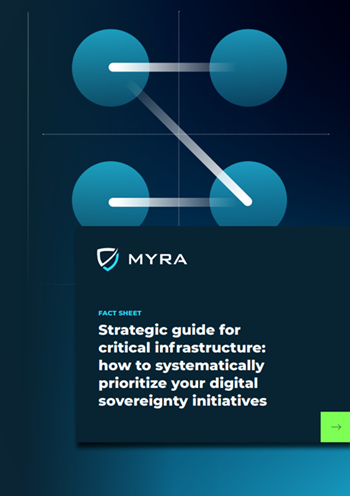
Strategy Guide: Sovereignty Switch

In many organizations, it is difficult to clearly prioritize digital sovereignty initiatives. The Sovereignty Switch is a compact guide that offers a structured approach to this issue and shows how central systems can be prioritized according to business criticality and migration effort and specifically converted to sovereign European solutions.

  • What criteria determine the criticality and migration effort of your systems?

  • How do you structure your sovereignty roadmap?

  • Where can sovereign “quick wins” be achieved particularly quickly?

Why digital sovereignty is so crucial

In light of geopolitical tensions, stricter regulations, and increasing cyber threats, digital sovereignty is becoming a key strategic focus for operators of critical infrastructure and NIS 2-regulated organizations.

  • Dependencies in the area of cloud, network, and security services pose significant risks

  • Hyperscalers outside the European legal jurisdiction exacerbate this risk

  • A gradual switch to European alternatives is a fundamental decision for greater controllability, legal certainty, and crisis resilience

Decision Guideline: Sovereignty Switch

The combination of business criticality and migration effort creates four clear decision scenarios that enable targeted prioritization of all migration projects.

Priority 2

Now (high criticality, low effort)

This is where sovereignty and compliance gains can be realized particularly quickly and visibly. Systems with high relevance and open interfaces, for which mature EU alternatives exist, should be given preference and migrated promptly. The risks and costs remain manageable, while the benefits are considerable – especially if non-European services have been used up to now. Such projects are predestined to serve as flagship projects and should be prominently featured and communicated in the roadmap.

Priority 2

Next (high criticality, high effort)

This concerns large-scale strategic projects: change is essential for sovereignty and resilience, but requires substantial investment and careful planning. European suppliers should be involved early on in pilot phases and joint development projects to ensure market readiness and integration.

Priority 3

Later (low criticality, low effort)

This field is ideal for pilot projects and experiments with low risk and low effort. Less critical, easily replaceable systems make it possible to test migration processes, governance, and change management. Successful projects strengthen trust in EU providers and pave the way for more demanding projects.

Priority 4

Load (low criticality, high effort)

Here, waiting is the rational strategy: the cost of conversion is disproportionate to the benefits or gains in sovereignty. Migration only becomes relevant when the system needs to be replaced, has reached the end of its life cycle, or regulatory requirements arise. Until then, the best approach is to observe, examine options, and concentrate resources on higher-priority areas.

Business criticality vs. migration complexity

Business criticality

Business criticality describes how strongly a system influences core business, the fulfillment of regulatory obligations, and the maintenance of security of supply. The higher the criticality, the more likely the system is to be prioritized early on in sovereignty and security initiatives.

  • Impact on revenue, value creation, and key business processes.

  • Significance for compliance, reporting, and supervisory obligations (e.g., NIS-2, DORA, KRITIS, GDPR).

  • Effects on security of supply, recovery times, and resilience in the event of failure.

migration complexity

Migration complexity describes how costly it is to switch a system to a sovereign alternative—technically, organizationally, and regulatorily. It results primarily from data structures, the interface landscape, and embedding in processes and role models.

  • Structure and scope of data, as well as the number and type of connected systems and interfaces.

  • Deep integration into processes, role and authorization concepts, and training requirements for employees.

  • Required evidence and adjustments for audits, reporting, and regulatory requirements.

special case

Application and Network Security

Services such as DDoS protection, CDN, WAF, and bot management are critical to the availability and performance of online services. Since they are usually connected via defined standard configurations and, as cloud solutions, do not require additional hardware or software, switching to European providers can be done with little effort. All that is required is to route the data traffic through the respective service provider. Despite their high importance, these services thus allow for a quick and low-risk transition.

Digitally confident with Myra

in just 3 steps

Icon showing a checklist inside a magnifying glass: symbol for review, audit and assessment of requirements

Download Fact Sheet

Learn in detail how to systematically prioritize sovereignty initiatives

Identify the need for action

In which areas are you dependent on non-European suppliers?

Get in touch

We help you on your path to digital sovereignty with our solutions

secure now

Protect yourself effectively against cyber attacks

We would be happy to show you how Myra improves your digital sovereignty in a free demo and answer all your questions.