New: AI Workspace – Secure AI for Organizations With Sensitive Data. Learn more.
Myra Protects Critical Services with Post-Quantum Cryptography
Quantum computers are evolving from a vision of the future into a real threat to conventional encryption methods, putting the foundations of today's IT security under increasing pressure. Myra is therefore focusing on quantum-secure technologies to effectively address current and future risks.

Quantum computers can solve certain mathematical problems much faster than classical computers and thus quickly render today's common encryption and signing methods obsolete. This jeopardizes fundamental security mechanisms such as the encryption of web portals, VPNs, email communication, and code signatures.
What is particularly critical is that attackers can already record encrypted data in transit today in order to decrypt it later using powerful quantum computers (“harvest now, decrypt later”). For sectors with particularly high confidentiality requirements (finance, healthcare, public), this means that data that should actually be protected in the long term will in fact be exposed in a few years.
Post-quantum cryptography: BSI and NIS-2 guidance
The German Federal Office for Information Security (BSI) and European partners are therefore explicitly calling on affected organizations to initiate the transition to post-quantum cryptography (PQC) and integrate it into their security and risk management processes. In the context of NIS-2, there is increasing pressure on companies to identify cryptographic dependencies and plan migration paths to quantum-resilient methods, as state-of-the-art security is mandatory here.
Risks for applications and networks
For applications and networks, the quantum threat means that confidential TLS connections will no longer be secure in the long term if they are based solely on today's standard procedures. APIs, online portals, and web applications are just as affected as machine-to-machine communication in data centers and cloud environments.
Cryptographic identities and trust anchors such as certificates or code signatures will also lose their significance if the underlying procedures are weakened by quantum attacks. This poses a structural risk: if the cryptographic basis is compromised, this will have a direct impact on the confidentiality and integrity of entire digital ecosystems.
Post-quantum cryptography as the answer
Post-quantum cryptography uses new cryptographic methods that are designed to withstand even quantum-based attack patterns. The US National Institute of Standards and Technology (NIST) has defined standards for key exchange and digital signatures that are intended to replace or supplement the methods commonly used today, such as RSA.

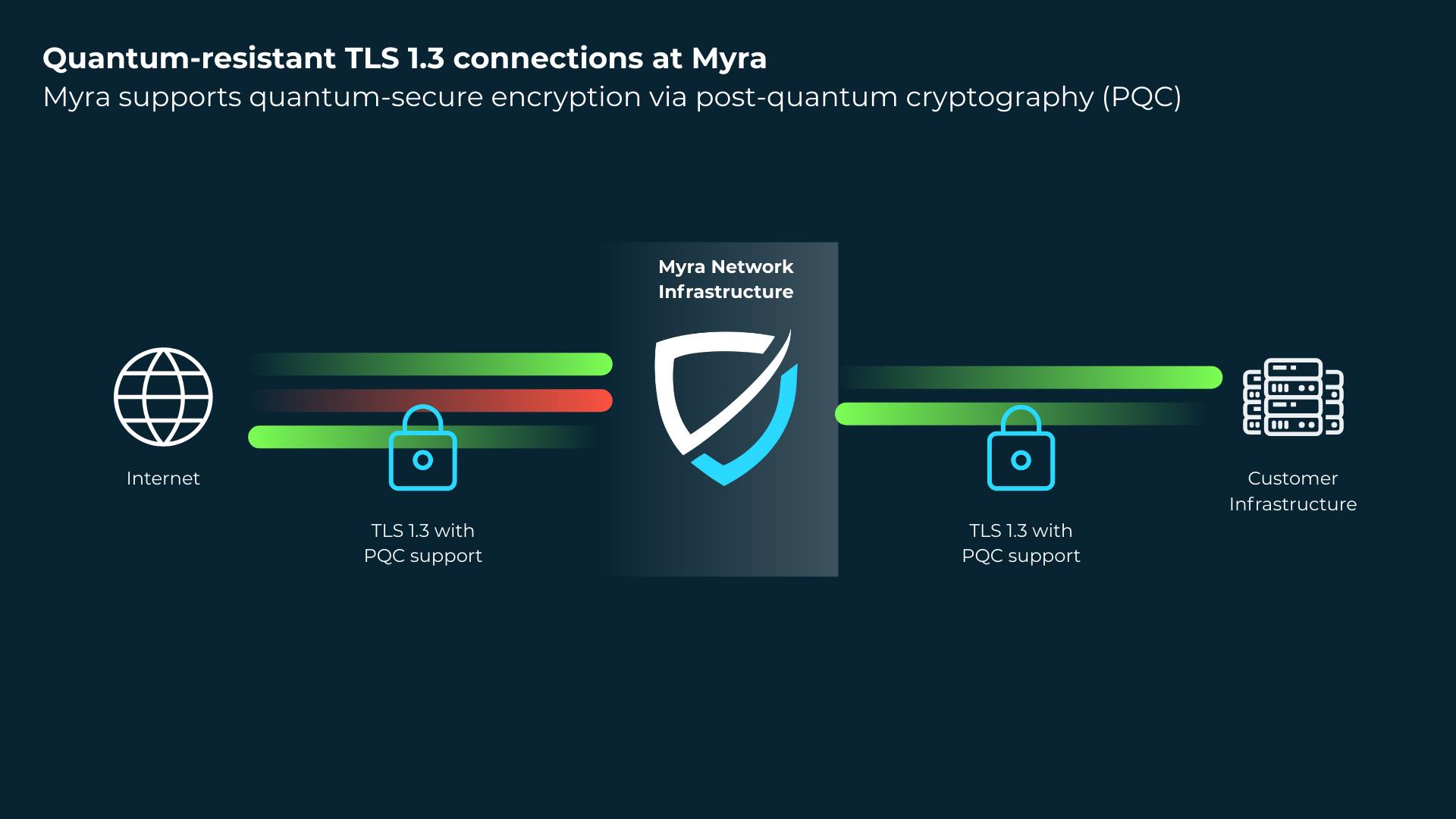
Traffic overview: Both connections between the user client and Myra and between Myra and the customer infrastructure support TLS 1.3 encryption with post-quantum cryptography.
TLS 1.3 is considered a foundation for the use of post-quantum cryptography on the web because it offers modern, lean handshakes and supports PQC extensions. This allows connections to be secured in such a way that key exchange and encryption are robust even against quantum attacks, without changing the connection model on the user side.
Myra consistently aligns its Security-as-a-Service platform with regulatory requirements, high performance, and modern cryptography to securely operate web applications, APIs, critical online services, and network infrastructures. By using quantum-resilient TLS connections based on post-quantum ciphers for TLS 1.3, customers are already protected against threats such as “harvest now, decrypt later” and future quantum attacks—while also being prepared for the requirements of NIS-2 and the post-quantum era.
About the author


Stefan Bordel
Senior Editor
About the author
Stefan Bordel has been working as Editor and Technical Writer at Myra Security since 2020. He is responsible for the strategic development and editorial management of all content formats – from website content and specialist publications to whitepapers, social media communication, and technical documentation. In this role, he combines solid expertise from IT journalism with in-depth technical understanding in the field of cybersecurity. As a long-time Linux enthusiast, he closely follows developments in the IT industry both professionally and personally.