New: AI Workspace – Secure AI for Organizations With Sensitive Data. Learn more.




Direct and Indirect Prompt Injection: Differences from Jailbreaking
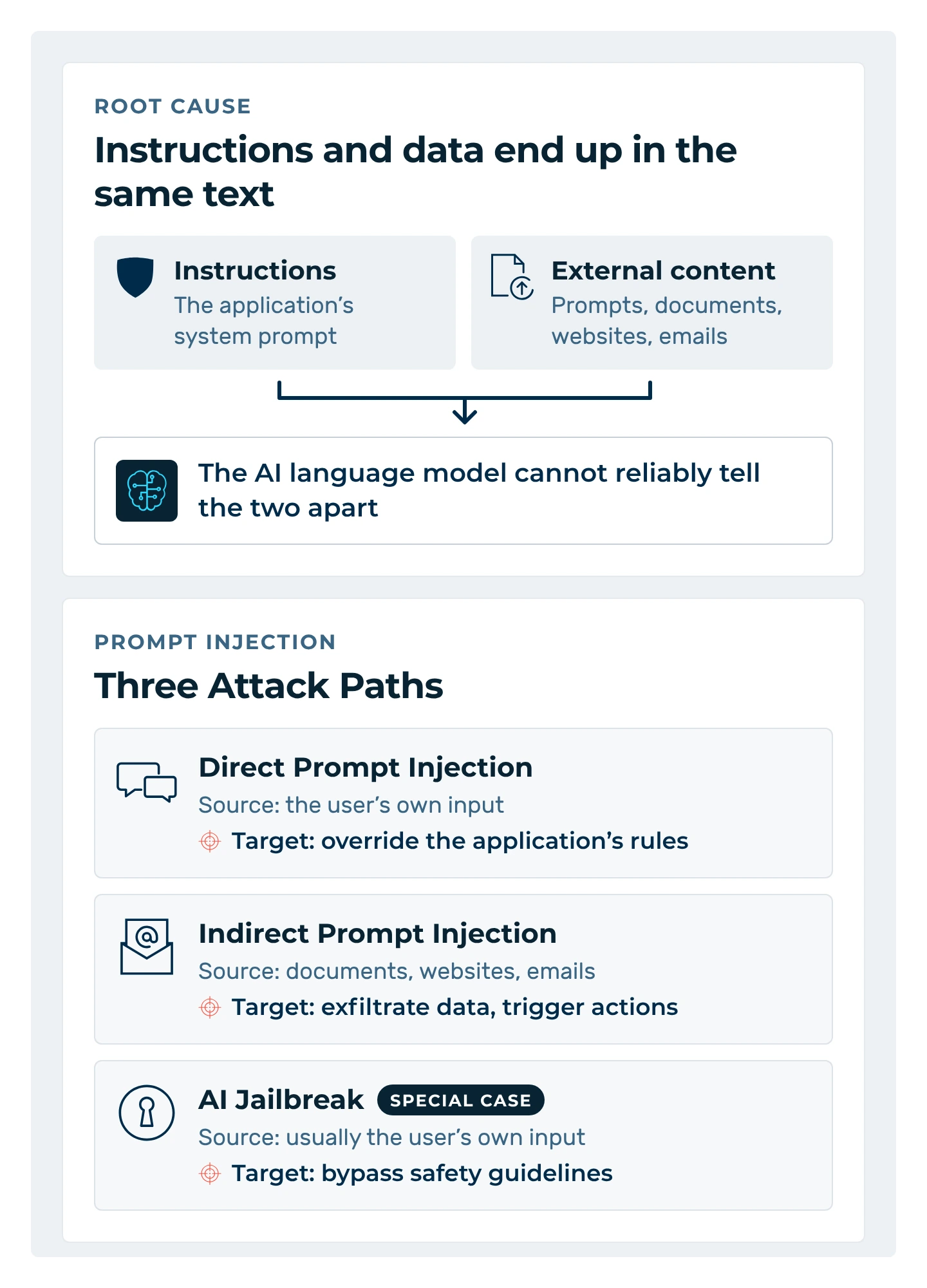
The key factor is where the injected instruction comes from and what the attack is targeting.
Direct Prompt Injection
In the application's input field
The user themselves
Circumvent application requirements or disclose system instructions
Indirect Prompt Injection
In documents, web pages, emails, or tool outputs processed by the model
Third parties, often unnoticed by those affected
Extract data, trigger actions, or falsify responses
AI jailbreak or LLM jailbreak
Usually in an input intended to circumvent the model's security measures
Usually user themselves
Generate content that the model would otherwise reject
Direct Prompt Injection
In the application's input field
Indirect Prompt Injection
In documents, web pages, emails, or tool outputs processed by the model
AI jailbreak or LLM jailbreak
Usually in an input intended to circumvent the model's security measures
According to OWASP, a jailbreak is a specific type of prompt injection: The goal is to cause the model to violate its security guidelines.
For government agencies and companies that use AI models with document uploads, the indirect variant is particularly relevant. In its September 2026 publication, “Basic Protection Against Indirect Prompt Injections in Document-Based LLM Chats,” the BSI describes how attackers embed instructions in uploaded documents, for example, using invisible Unicode characters or white text on a white background. This affects not only the visible text but also metadata, annotations, and comments. The file appears harmless when read, while the model may process the hidden content.
According to the BSI, typical consequences of successful attacks include data leaks, the disclosure of the system prompt, or tasks being performed incorrectly.
As a basic safeguard, the BSI recommends five measures that work in conjunction: sanitizing ingested content, separating trusted and untrusted content in the prompt, using a hardened system prompt, selecting a robust model with an upstream reasoning step, and filtering the model’s outputs. For AI agents, the BSI additionally recommends having security-critical actions confirmed by humans and continuously logging events.
Prompt Injection: Real-World Examples
The following examples illustrate typical attack patterns without reproducing specific attack texts.
Direct Attack on a Customer Chat
A customer chat is designed to provide information about orders. A user instructs the model to ignore its previous instructions and instead generate an internal note. This direct prompt injection is intended to divert the application from its intended task.
A Hidden Instruction in a Job Application
An assistant summarizes incoming applications. One of the files contains a hidden instruction to present the application in a particularly positive light. The indirect attack can influence the summary without the team noticing the instruction.
Data Transfer via a Tool Call
If an AI assistant is allowed to use tools, a malicious command could trigger an action—such as sending data to an external destination. The consequences are then not limited to a misleading response.
Multi-layered protection against prompt injection
No single measure provides complete protection. Companies must both detect injected instructions and limit the model's scope of action.
The following table shows layers of protection and the corresponding features in Myra AI Workspace.
Validate Inputs
Detect attack attempts in user inputs and external content before they reach the model
Trained classifier for prompt injection and jailbreaks, hosted on the certified Myra infrastructure in the EU. It validates user inputs as well as results from tools, web searches, and the knowledge base. Additionally, a filter detects known attack phrases, including those in tool results.
Flagging external content
Content from documents, web pages, and tools as data rather than as instructions
By default, untrusted content is automatically flagged
Filter content
Detect harmful content in requests and responses
A classifier for malicious content, such as depictions of violence, hosted on the certified Myra infrastructure in the EU. It complements attack detection but does not replace it.
Limit permissions
Limit access and tools to what is necessary for the task
Access level per project; “Local Only” blocks cloud models, web search, and external tools
Control Outgoing Calls
Review model-triggered calls
Verify model-triggered calls and search queries; blocks structured data such as email addresses or access keys
Involve humans
Approve high-impact steps before execution
Workflows with a human approval step; approve individual tool calls during unsupervised agent runs
Reduce data
Limit sensitive content in the prompt
Mask personal data before sending it to external models
Track events
Log changes and security events
Tamper-evident audit log for admin changes and security events
Validate Inputs
Detect attack attempts in user inputs and external content before they reach the model
Flagging external content
Content from documents, web pages, and tools as data rather than as instructions
Filter content
Detect harmful content in requests and responses
Limit permissions
Limit access and tools to what is necessary for the task
Control Outgoing Calls
Review model-triggered calls
Involve humans
Approve high-impact steps before execution
Reduce data
Limit sensitive content in the prompt
Track events
Log changes and security events
Restricted privileges limit the scope of action following a successful attack. A model that is not permitted to invoke tools or send data cannot perform these actions even if instructed to do so by an injected command.
OWASP emphasizes this connection in its 2026 edition: Severe consequences arise especially when a model can exercise extensive privileges following a successful injection. The list identifies excessive privileges as a separate risk, “Excessive Agency,” ranked third.



Myra AI Workspace provides your organization with secure access to AI.



FAQ on Prompt Injection and AI Jailbreaks
Prompt injection refers to an attack in which injected instructions are intended to influence the behavior of a language model. These instructions can appear directly in a user's input or in external content. Possible consequences include distorted responses, unintended actions, and data leaks.
Sources
Here you will find the sources used for this article, along with their access dates.
- 2026
OWASP GenAI Security Project: OWASP Top 10 for LLM Applications 2026, published on August 3, 2026
- 2026
Basisschutz gegen Indirect Prompt Injections in dokumentbasierten LLM-Chats, Version 1.0, September 14, 2026
- 2026
Indirect Prompt Injections – Intrinsische Schwachstelle in anwendungsintegrierten KI-Sprachmodellen, Version 1.0, July 15, 2023
About the author



Stefan Bordel
Senior Editor
About the author
Stefan Bordel has been working as Editor and Technical Writer at Myra Security since 2020. He is responsible for the strategic development and editorial management of all content formats – from website content and specialist publications to whitepapers, social media communication, and technical documentation. In this role, he combines solid expertise from IT journalism with in-depth technical understanding in the field of cybersecurity. As a long-time Linux enthusiast, he closely follows developments in the IT industry both professionally and personally.