New: AI Workspace – Secure AI for Organizations With Sensitive Data. Learn more.


At one look
- 1. How the Four Dimensions Fit into the Framework
- 2. European AI, GDPR-Compliant AI, and the Data Privacy Framework: What These Terms Mean
- 3. Typical Objections to Sovereign AI
- 4. Sovereign AI for Executive Management, IT Leadership, Procurement, and the Public Sector
- 5. Questionnaire for Evaluating Sovereign AI Providers
- 6. Pseudonymization, Operating Options, and Pricing
What Is Sovereign AI? A Brief Definition
For businesses and government agencies, this generally does not mean training their own language model. What matters is the interplay between the operator, the architecture, and the contract. Contractual commitments are only as binding as the law to which the operator is subject. And a configuration only provides protection to the extent that the server technically enforces it.
Four assessment dimensions and the EU Cloud Sovereignty Framework help evaluate sovereign AI. A questionnaire supports the provider assessment.
Sovereign AI: National Infrastructure or In-House Control?
The term is used in two senses. For nations and the EU, “sovereign AI” – often referred to internationally as “Sovereign AI” – means having their own computing capacity, research, and model development. The European Commission, for example, has launched a call for proposals for up to seven AI gigafactories and presents them as a contribution to Europe’s technological sovereignty. The issue at stake is who will build the next generation of models.
A municipality, a health insurance provider, or a small-to-medium-sized enterprise does not train cutting-edge models. For these organizations, more concrete questions arise: Can it be determined where inputs and documents are sent? Can this be verified for regulatory authorities or auditors? And will it be possible to switch to another provider in two years without data loss? The answers to these questions can be verified.
The Four Dimensions of Sovereign AI
Sovereignty cannot be determined by a single characteristic. The following four dimensions summarize the key assessment questions and the evidence you can require from a provider.
Data Location
Where are inputs, files, logs, and backup copies stored? In which country does the model run? Who manages the keys?
Specified locations by data type in the DPA and product documentation; documentation provided upon request indicating where the data was processed
Jurisdiction and Operations
Which law governs each entity in the chain: contractual partners, hosting providers, model operators, and web search? From where is the service operated and supported?
Model documentation, license text, and the provider’s information regarding the training data
Model origin
Who developed and trained the model, who operates it, and under which license?
Model documentation, license text, and the provider’s information regarding the training data
Dependencies
What happens if a provider changes prices or terms, or shuts down a model?
Export to open formats, provisions for the end of the contract, and a tested alternative model
Data Location
Where are inputs, files, logs, and backup copies stored? In which country does the model run? Who manages the keys?
Jurisdiction and Operations
Which law governs each entity in the chain: contractual partners, hosting providers, model operators, and web search? From where is the service operated and supported?
Model origin
Who developed and trained the model, who operates it, and under which license?
Dependencies
What happens if a provider changes prices or terms, or shuts down a model?
Data Location and Jurisdiction of Sovereign AI: Two Separate Issues
The two are often confused. In its Cloud Security Principles, the UK’s National Cyber Security Centre points out that the question of legal jurisdiction can be more complex than simply clarifying the locations of storage, processing, and access. It identifies the provider’s legal domicile and the locations from which the service is operated and supported as separate factors. The BSI’s C5 criteria catalog also requires the system description to include information on jurisdiction and disclosure obligations, not just data location.
The best-known example is the US CLOUD Act of 2018. Under 18 USC § 2713, a provider of electronic communications or cloud services must secure, retain, or disclose content and data in its possession, custody, or under its control, regardless of whether it is stored inside or outside the United States. This obligation does not arise automatically. It requires a proceeding under the Stored Communications Act, such as a search warrant, a court order, or a subpoena. What matters, therefore, is control over the data, not merely the server’s location.
The US Department of Justice explains which companies are subject to US jurisdiction in its April 2019 white paper. According to the white paper, this jurisdiction is not limited to US companies, companies headquartered in the US, or US-owned companies, but it is also not unlimited. For companies offering services in the US, jurisdiction depends heavily on the circumstances of the individual case; for subsidiaries, it depends on whether the obligated company has sufficient control over the data stored there. At the same time, the Department emphasizes that the CLOUD Act has not expanded the jurisdiction of US courts over companies.
The ability to challenge an order is limited. A statutory right to file a motion based on a conflict with foreign law (18 U.S.C. § 2703(h)) exists only with respect to countries that have a CLOUD Act agreement – currently the United Kingdom and Australia, but not the EU. General principles of comity under international law remain unaffected by this. In addition, a court may prohibit the service provider from informing affected customers about the order.
For the purposes of this assessment, this means: A data center in Frankfurt determines the location, not the jurisdiction. Ask the provider to explain whether and why it is subject to US law. Also check whether and for how long prompts, responses, uploaded files, and logs are stored, since only data actually held by the provider can be disclosed. Short storage periods or no storage at all reduce the scope of the data subject to disclosure but do not affect the question of jurisdiction.
Model Origin: Who trained the AI model?
Anyone using a model should know where it comes from. In its Opinion 28/2024 (adopted on December 17, 2024), the European Data Protection Board stated that supervisory authorities may assess whether the controller using a model has determined that it was not developed through the unlawful processing of personal data. The depth of this assessment depends on the risk associated with the model’s use.
Here, too, origin and operation must be distinguished. An open model (open-weight model) published by a company in the US or China can run entirely on servers in the EU. The developer does not receive the inputs. Questions remain that the location of operation does not answer: Which license applies? What is known about the training data? How does the model behave when dealing with topics that are politically sensitive in the country of origin? Include these points in the assessment as a documented consideration, not automatically placed on an exclusion list.
Ask the provider to specify which model is being used, who developed it, and under which license it runs. Record this information in your documentation.
Dependencies only become apparent when switching providers
An AI workspace where prompts, projects, and knowledge bases have accumulated over two years is difficult to leave if the export consists only of a PDF of the chat history. And anyone who has tested only one model has no alternative if that provider changes its terms.
Legislators are also addressing this issue. Chapter VI of the EU Data Act requires providers of data processing services, including SaaS services, to enable users to switch to another provider starting September 12, 2025; as of January 12, 2027, they may no longer charge switching fees for this. For financial firms, DORA (Art. 28, para. 8) requires exit strategies for ICT services that support critical or important functions. Your legal department should review whether and how these obligations apply to a specific AI service.


How the Four Dimensions Fit into the Framework
Data Location
SOV-3 Data & AI Sovereignty
Model Origin
SOV-1 Strategic Sovereignty, SOV-2 Legal & Jurisdictional Sovereignty, and SOV-4 Operational Sovereignty
Dependencies
SOV-3 Data & AI Sovereignty, SOV-5 Supply Chain Sovereignty, and SOV-6 Technology Sovereignty
The framework also includes
SOV-4 Operational Sovereignty, SOV-6 Technology Sovereignty
Zusätzlich im Framework
SOV-7 Security & Compliance Sovereignty, and SOV-8 Environmental Sustainability
Data Location
SOV-3 Data & AI Sovereignty
Model Origin
SOV-1 Strategic Sovereignty, SOV-2 Legal & Jurisdictional Sovereignty, and SOV-4 Operational Sovereignty
Dependencies
SOV-3 Data & AI Sovereignty, SOV-5 Supply Chain Sovereignty, and SOV-6 Technology Sovereignty
The framework also includes
SOV-4 Operational Sovereignty, SOV-6 Technology Sovereignty
Zusätzlich im Framework
SOV-7 Security & Compliance Sovereignty, and SOV-8 Environmental Sustainability
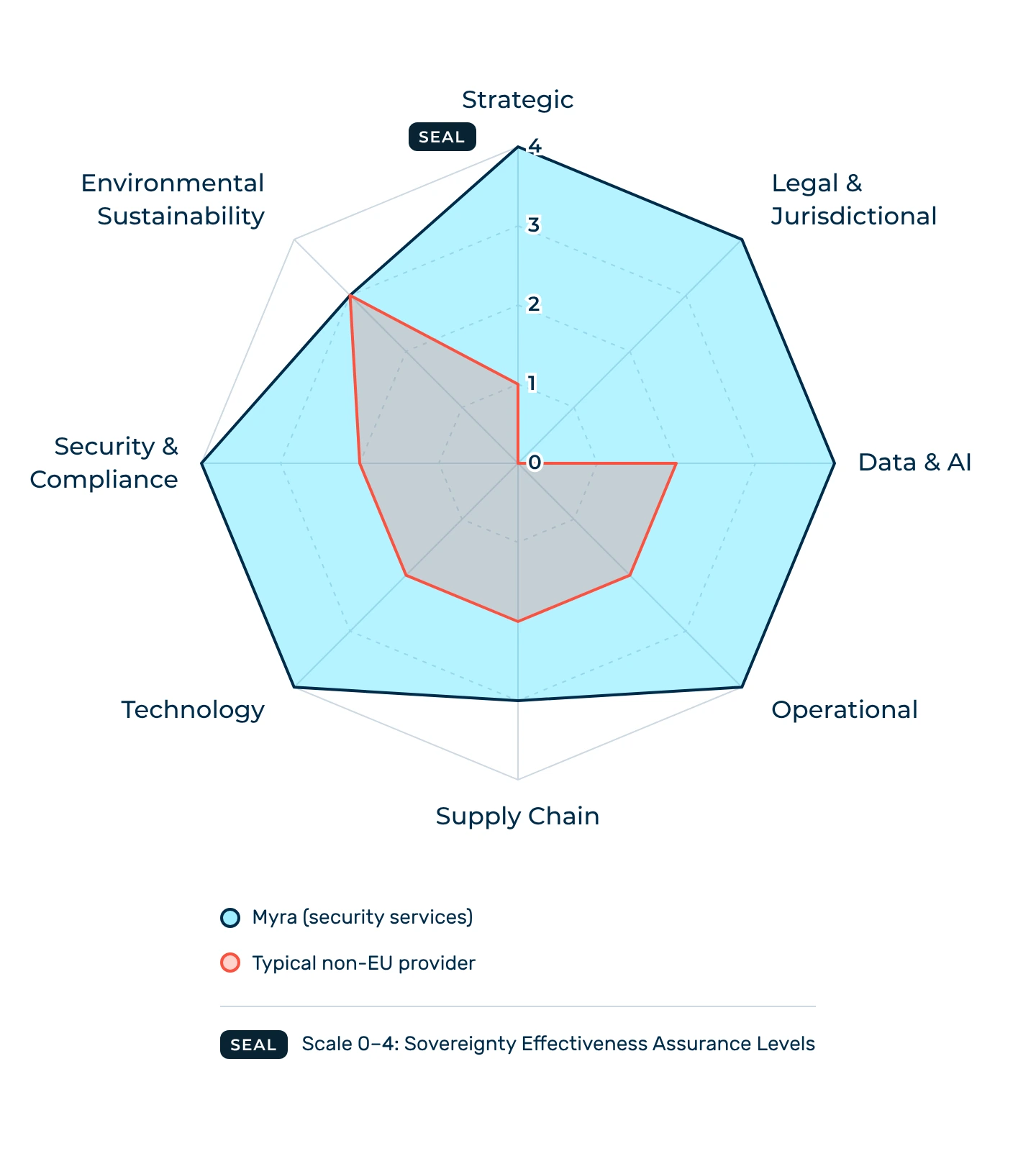
Myra has self-assessed its protection services – such as DDoS protection, WAF, and CDN – based on the framework’s influencing factors and published the results in the fact sheet “How to Strengthen Your Digital Security and Independence with Myra.” For Myra AI Workspace, the classification depends on the configuration, particularly whether an organization permits external models.
For providers outside the European Union, some of the criteria required by the Cloud Sovereignty Framework are simply impossible to meet – particularly with regard to Legal & Jurisdictional Sovereignty.”



Comparison of Solution Types for Sovereign AI
AI service from a non-European provider, used directly
EU region can be selected in some cases; the law of the provider’s country of incorporation applies, even if data is stored in the EU
Mostly proprietary; information is limited
Depends on export functions and contract
Hyperscaler offering with an EU region or EU data boundary
EU; the provider remains part of a non-European corporate group
Wide selection, mostly proprietary
Check for lock-in to platform services
Sovereign cloud structure: EU operating company using non-European technology
EU; EU operator; dependence on the manufacturer’s technology and licenses remains
as with the underlying platform
depending on the design
European AI provider
predominantly in the EU; depending on the function, subprocessors outside the EU are possible, Headquartered in the EU; review US connections such as business operations in the US and the chain of subprocessors
Proprietary models, partly open
Generally good; check the scope of exports
EU operator with self-operated open models
EU; the operator is the determining factor; check for US connections and subcontractors
The developer may be based outside the EU; check the license
High; models are interchangeable
In-house operation (on-premises)
Own data center; own
as with open models
Complete; costs for hardware, operation, and updates
AI service from a non-European provider, used directly
EU region can be selected in some cases; the law of the provider’s country of incorporation applies, even if data is stored in the EU
Hyperscaler offering with an EU region or EU data boundary
EU; the provider remains part of a non-European corporate group
Sovereign cloud structure: EU operating company using non-European technology
EU; EU operator; dependence on the manufacturer’s technology and licenses remains
European AI provider
predominantly in the EU; depending on the function, subprocessors outside the EU are possible, Headquartered in the EU; review US connections such as business operations in the US and the chain of subprocessors
EU operator with self-operated open models
EU; the operator is the determining factor; check for US connections and subcontractors
In-house operation (on-premises)
Own data center; own
European AI, GDPR-Compliant AI, and the Data Privacy Framework: What These Terms Mean
European AI
“European” usually refers to the provider’s headquarters, not the location of data processing. Mistral AI, for example, is headquartered in Paris and, according to its Help Center, stores data in the EU by default; depending on the function, the company may temporarily transfer data to subprocessors outside the EU, whose locations the Trust Center lists. The company describes this transparently. It shows that “providers from Europe” and “processing exclusively in Europe” are two different statements.
GDPR-Compliant AI
“GDPR-compliant” is not a designation that a provider can assign to you. The purpose, legal basis, contract under Article 28 of the GDPR, and, if applicable, a data protection impact assessment remain the responsibility of the controller. In its guidance dated May 6, 2024, the Data Protection Conference assumes that a data protection impact assessment will often be required when using AI. It also considers technically closed systems to be preferable from a data protection perspective. A sovereign AI environment facilitates this assessment but does not replace it.
EU-US Data Privacy Framework
Many argue that the EU-US Data Privacy Framework has settled the matter. It succeeded the Privacy Shield, which the European Court of Justice had declared invalid in 2020 (Schrems II), and is based on Implementing Decision (EU) 2023/1795 of July 10, 2023. The General Court of the EU dismissed the lawsuit filed by the on September 3, 2025 (T-553/23); an appeal has been pending before the European Court of Justice since October 31, 2025 (C-703/25 P).
A ruling by the US Supreme Court on June 29, 2026 (Trump v. Slaughter) has created additional uncertainty: Since then, the US President has been able to remove members of the Federal Trade Commission without providing a reason. The adequacy decision relies, among other things, on the FTC as an independent oversight body for certified companies. On July 31, 2026, the European Data Protection Board asked the Commission to examine whether the ruling affects the basis of the decision. The decision remains in effect. Anyone relying on it should document what alternative would be considered should it be revoked.
Above all, however, the Framework governs transfers to certified US companies. It does not protect against access under the CLOUD Act to data stored in the EU.
What the GDPR and the EU AI Act Require
The GDPR subjects transfers to third countries to certain conditions (Art. 44 et seq.). Art. 48 of the GDPR stipulates that judgments and decisions by third-country authorities requiring a transfer may only be recognized or enforced on the basis of international agreements, without prejudice to other grounds for transfer. One such agreement is the EU-US Mutual Legal Assistance Agreement, which has been in effect since 2010. In contrast, there is no CLOUD Act agreement for direct orders to service providers; negotiations have been ongoing since 2019. A conflict therefore arises primarily when US authorities contact the service provider directly instead of using the mutual legal assistance channel.
This conflict primarily affects the service provider. As a data processor, the service provider may process personal data only on your instructions, unless required to do so by Union law or the law of a Member State (Art. 28(3)(a), Art. 29 GDPR). US law does not fall under this category. If a service provider discloses data in response to a US order, it is acting outside the scope of your instructions in that respect (see Art. 28(10) GDPR). Your obligations as a data controller begin earlier: You may only engage processors that provide sufficient safeguards (Art. 28(1) GDPR), and you must take into account the risk of access by third countries when implementing technical and organizational measures (Art. 32 GDPR). Digtal sovereignty is a way to demonstrably meet these requirements.
Typical Objections to Sovereign AI
“Our hyperscaler offers an EU solution.”
EU regions, data borders, and sovereign cloud constructs significantly improve the situation regarding data location – and, in some cases, operations as well. The decisive factor is how much access, control, and technical dependency remain with the non-European corporation. This is precisely what the Cloud Sovereignty Framework evaluates. The Commission’s first procurement round shows that while such offerings can meet a minimum standard, European providers with their own technology were rated higher. Ask for the rationale behind the rating for each objective.
“An open model on a German server is automatically sovereign.”
Operation in Germany answers the question of location. For jurisdiction, what matters is who performs the processing, not where the model weights come from; therefore, the operator and its subcontractors must be examined. The model’s origin remains a separate consideration: the license, training data, and model behavior should be documented. One advantage of open models is their interchangeability. Those who maintain multiple models of different origins reduce dependencies.
“We’ll handle that in the contract.”
Contracts are the appropriate instrument for location commitments, notice periods, export rights, and proof of deletion. They offer no protection against a disclosure order under the law to which the operator is subject: If a provider discloses data in response to such an order, it is acting outside your instructions in that regard, and a court may even prohibit it from informing you of this. Therefore, the contract, corporate structure, and technical enforcement must all be considered together during the review.
Sovereign AI for Executive Management, IT Leadership, Procurement, and the Public Sector
Executive Management: Ensuring Freedom of Action
For executive management, sovereign AI is a matter of freedom of action. Three risks are of primary concern: a disclosure order under foreign law, short-term changes in prices, terms, or availability, and high switching costs. The key decision is which data categories may be processed at what level – for example, personnel and health data only within the EU, while general research may also involve external models. The other roles implement this decision.
IT Management: Verifying Technical Enforcement
For IT management, the key issue is whether requirements can be technically enforced. Can it be specified on a per-project or per-organization basis which models are permitted to respond? Does the server reject unauthorized requests before data leaves the organization? Can it be verified for each request where it was processed? Additional considerations include integration with identity management, logging, and the transmission of events to a SIEM.
Procurement: Make Responses Comparable
For procurement, the questionnaire below serves as a working tool. It has proven effective to classify each question as a mandatory or recommended criterion and to require written responses. Red flags include evasive answers, references to future features, and promises made in marketing materials but not included in the contract or the General Terms and Conditions (AVV).
Public Sector: Defining Minimum Requirements
Government agencies and public enterprises can use the Cloud Sovereignty Framework as a template for minimum requirements in solicitations. The BSI-C5 certificate, which includes information on jurisdiction and disclosure obligations, can also serve as proof. For AI services , contracting authorities should separately verify whether an existing certificate applies to the infrastructure or also to the AI application itself.
Questionnaire for Evaluating Sovereign AI Providers
Formulate the questions in writing for each stage of the processing chain. The two right-hand columns indicate how to recognize reliable answers and when you should ask for clarification.
1
With which company are we entering into the contract? Which law and which court of jurisdiction apply?
The contract specifies the company, governing law, and place of jurisdiction.
Sales company with no information provided about the corporate group
2
Where and for how long are entries, files, logs, and backup copies stored? What data is stored at other locations (registration, billing, notifications, metadata)?
Locations and retention periods by data type
Generic “within the EU,” no retention periods
3
In which country does inference take place for each published model, including for web search and integrations?
Location per model and proof per request
“Generally” without proof
4
Who hosts the application, who operates the models, and which subcontractors are involved? How far in advance do you announce changes?
Public registry, advance notice with right to object
List available only upon request; no deadline
5
Is any entity in the chain subject to a legal system under which authorities outside the EU can demand disclosure? How do you inform us of such a request, to the extent you are permitted to do so?
Reasoned statement for each entity, including business operations in the US; contractual obligation to notify
Only a reference to the data center location or company headquarters
6
Which models are available? Who developed them, and under what license do they operate?
Model, developer, and license for each model
“Custom model mix” without details
7
Can you specify per project which models are allowed to respond, and does the server enforce this, even for alternative routes?
Server-side enforcement, logged
Policy or training only
8
Do you use our data for training? Does this depend on the pricing plan?
Contractually prohibited; exceptions only with consent
Regulated only in privacy notices or depending on the plan
9
What data will we receive back at the end of the contract, in what format, and within what timeframe?
Export in open formats, timeframe, confirmation of deletion
Export only as PDF
10
Which second model have we tested for critical tasks in case a provider goes down?
Multiple models via a single interface; fallback rules configurable
One model, one provider
11
What exactly do certificates and attestations refer to?
Scope specified: Company, Infrastructure, and Application
Certificate without a specified scope
12
How do you classify your offering according to the EU Cloud Sovereignty Framework?
SEAL level per target with justification
Overall rating without justification
1
With which company are we entering into the contract? Which law and which court of jurisdiction apply?
2
Where and for how long are entries, files, logs, and backup copies stored? What data is stored at other locations (registration, billing, notifications, metadata)?
3
In which country does inference take place for each published model, including for web search and integrations?
4
Who hosts the application, who operates the models, and which subcontractors are involved? How far in advance do you announce changes?
5
Is any entity in the chain subject to a legal system under which authorities outside the EU can demand disclosure? How do you inform us of such a request, to the extent you are permitted to do so?
6
Which models are available? Who developed them, and under what license do they operate?
7
Can you specify per project which models are allowed to respond, and does the server enforce this, even for alternative routes?
8
Do you use our data for training? Does this depend on the pricing plan?
9
What data will we receive back at the end of the contract, in what format, and within what timeframe?
10
Which second model have we tested for critical tasks in case a provider goes down?
11
What exactly do certificates and attestations refer to?
12
How do you classify your offering according to the EU Cloud Sovereignty Framework?
Myra AI Workspace in the Sovereignty Check: Myra’s Responses
Myra Security has been protecting government agencies, banks, insurance companies, and operators of critical infrastructure from cyberattacks for years. The company is owner-managed, has exclusively European shareholders from the DACH region, and is headquartered in Munich, where its entire management team is based. The company develops and operates its security services in Germany on its own hardware.
Independent audits confirm this security expertise: Myra holds ISO 27001 certification based on IT-Grundschutz, a BSI C5 Type 2 certificate, and KRITIS certification in accordance with Section 8a(3) of the BSIG, as well as PCI DSS and IDW PS 951 Type 2 (ISAE 3402). Myra AI Workspace leverages this security expertise and runs on Myra’s own infrastructure in Germany. The platform itself is not yet covered by these certifications; audits in accordance with BSI C5 and PCI DSS are currently underway.
The following table answers the list of questions. It is based on the Terms of Use (as of August 14, 2026), the Data Processing Agreement (Version 1.1.1 dated August 21, 2026), the Privacy Policy (as of October 16, 2026), and the Myra AI Workspace product documentation.
1 · Contracting Parties, Governing Law, Jurisdiction
Myra Security GmbH, Munich. German law applies. For merchants, legal entities under public law, and special funds under public law, Munich is the exclusive place of jurisdiction.
2 · Storage Locations
Application servers and databases run on a virtualization cluster operated by Myra in a data center in Germany, not on a third-party public cloud. Myra sends service emails via its own mail servers. Myra stores conversations and uploaded files and automatically deletes them after a configurable period (default: 90 days), unless your organization has specified a different retention period. Your organization may set shorter retention periods for inquiry logs. According to the AVV, contractually agreed-upon data processing generally takes place exclusively within the EU or the EEA; an exception applies only if the organization selects a model from a provider outside the EU/EEA. For push notifications from the mobile apps, Myra uses the services of Apple and Google.
3 · Location of Inference
Models operated by Myra run on Myra’s EU infrastructure. External models run at the respective provider’s location. When the EU region restriction is enabled, the server only allows EU-hosted providers and Myra models, even for alternative routes; web searches are then routed through a European search provider. Regardless of this, Myra AI Workspace logs for each request the jurisdiction in which it was actually processed: in the EU, outside the EU, or unverifiable.
4 · Hosting and Subcontracted Processors
Myra operates the application and its own models itself. The subprocessors, including external model providers, are listed in a public registry in the Trust Center, along with planned changes and change history. According to the General Terms and Conditions, Myra will provide at least 30 days’ advance notice via email regarding the addition or replacement of a subprocessor; customer organizations may object within 30 days for legitimate data protection reasons.
5 · Governing Law and Disclosure Requests
Myra Security GmbH is headquartered in Munich and has neither a US parent company nor a US subsidiary. However, the corporate structure alone does not answer the question of US jurisdiction; business activities in the US and the subcontractors used – which Myra publicly lists in the Trust Center – are also decisive factors. For the models operated by Myra, no external model provider is involved in the processing. Jurisdiction depends on who performs the processing, not on where the model weights originate. For external models, the legal situation must be assessed separately: If an organization uses a model from a US provider such as OpenAI or Anthropic – which the organization makes available based on a pricing plan or which the administration approves – the law of that provider also applies to these requests. Data is transferred to an external provider only if the organization selects or activates a model from that provider. For providers outside the EU/EEA, Myra bases the transfer on the safeguards under Art. 44 et seq. of the GDPR, such as the EU-US Data Privacy Framework or EU Standard Contractual Clauses, and conducts the required transfer impact assessment. Myra complies with official requests for disclosure only to the extent that a legal obligation exists and notifies the client organization in advance, to the extent permitted.
6 · Models, Developers, License
The models operated by Myra are open models (open-weight models) from various developers. Currently, these include Qwen 3.8 (27B) from Alibaba Cloud in China, Gemma 4 (31B) from Google in the US, and Mistral Small 4 from Mistral AI in France. They run exclusively on Myra’s servers; input data is not transmitted to the developers. All three models are licensed under the Apache 2.0 open-source license, which permits commercial use, customization, and operation on one’s own infrastructure. Additionally, models from 20+ providers can be integrated. The request log documents the model that generated a response.
7 · Server-Side Enforcement
Yes. For each project, the access level “Local Only” can be set. In this case, only Myra models are available; cloud models, web search, and external connectors are blocked, and the server verifies that each response originated on a Myra server. Code execution remains available because it runs in Myra’s own environment without network access. The EU region restriction can be enabled per gateway; Myra can configure it organization-wide upon request, and lower-level settings cannot override this restriction. By default, it is not enabled, so organizations can use non-European models if needed. Myra recommends enabling the restriction.
8 · Training
Myra does not use customer data to train AI models (Terms of Use, Section 5.4). Exceptions require explicit consent, which customers may revoke at any time. Commercial model providers prohibit the use of API content for training under their respective terms and conditions.
9 · Contract Termination and Export
After the contract ends, a 30-day export window is available. The export includes, among other things, complete conversations and messages, as well as projects, agents, workflows, prompts, roles, and configuration in CSV and JSON formats. For security reasons, login credentials and keys are not included; knowledge base files are exported as extracted text. Subsequently, Myra either returns or deletes the data in accordance with data protection regulations; Myra provides the deletion log upon request.
10 · Fallback Model
Myra AI Workspace integrates models via a unified, OpenAI-compatible interface. Routing rules, fallback chains, and a circuit breaker redirect requests to a different model in the event of disruptions. If a provider discontinues a model, Myra notifies you immediately and provides a replacement model whenever possible. Your organization should test which fallback model is suitable for a critical task.
11 · Scope of Certifications
The certifications and attestations mentioned apply to Myra as a company and its security services; Myra provides certificates and audit reports upon request under an NDA. Myra AI Workspace itself is not yet certified; audits for BSI C5 and PCI DSS are currently underway. The platform is subject to the security measures described in the Terms of Use, including encryption of data at rest using AES-256, additional encryption of access keys using a master key stored outside the database, and an audit log secured by a cryptographic hash chain.
12 · Cloud Sovereignty Framework
A self-assessment based on the framework is available for Myra’s security services (Fact Sheet). For Myra AI Workspace, the classification depends on the configuration: With the “Local Only” access level, all model requests run exclusively on Myra’s servers; if external models are permitted, the terms and legal framework of the respective provider also apply to these requests.
1 · Contracting Parties, Governing Law, Jurisdiction
Myra Security GmbH, Munich. German law applies. For merchants, legal entities under public law, and special funds under public law, Munich is the exclusive place of jurisdiction.
2 · Storage Locations
Application servers and databases run on a virtualization cluster operated by Myra in a data center in Germany, not on a third-party public cloud. Myra sends service emails via its own mail servers. Myra stores conversations and uploaded files and automatically deletes them after a configurable period (default: 90 days), unless your organization has specified a different retention period. Your organization may set shorter retention periods for inquiry logs. According to the AVV, contractually agreed-upon data processing generally takes place exclusively within the EU or the EEA; an exception applies only if the organization selects a model from a provider outside the EU/EEA. For push notifications from the mobile apps, Myra uses the services of Apple and Google.
3 · Location of Inference
Models operated by Myra run on Myra’s EU infrastructure. External models run at the respective provider’s location. When the EU region restriction is enabled, the server only allows EU-hosted providers and Myra models, even for alternative routes; web searches are then routed through a European search provider. Regardless of this, Myra AI Workspace logs for each request the jurisdiction in which it was actually processed: in the EU, outside the EU, or unverifiable.
4 · Hosting and Subcontracted Processors
Myra operates the application and its own models itself. The subprocessors, including external model providers, are listed in a public registry in the Trust Center, along with planned changes and change history. According to the General Terms and Conditions, Myra will provide at least 30 days’ advance notice via email regarding the addition or replacement of a subprocessor; customer organizations may object within 30 days for legitimate data protection reasons.
5 · Governing Law and Disclosure Requests
Myra Security GmbH is headquartered in Munich and has neither a US parent company nor a US subsidiary. However, the corporate structure alone does not answer the question of US jurisdiction; business activities in the US and the subcontractors used – which Myra publicly lists in the Trust Center – are also decisive factors. For the models operated by Myra, no external model provider is involved in the processing. Jurisdiction depends on who performs the processing, not on where the model weights originate. For external models, the legal situation must be assessed separately: If an organization uses a model from a US provider such as OpenAI or Anthropic – which the organization makes available based on a pricing plan or which the administration approves – the law of that provider also applies to these requests. Data is transferred to an external provider only if the organization selects or activates a model from that provider. For providers outside the EU/EEA, Myra bases the transfer on the safeguards under Art. 44 et seq. of the GDPR, such as the EU-US Data Privacy Framework or EU Standard Contractual Clauses, and conducts the required transfer impact assessment. Myra complies with official requests for disclosure only to the extent that a legal obligation exists and notifies the client organization in advance, to the extent permitted.
6 · Models, Developers, License
The models operated by Myra are open models (open-weight models) from various developers. Currently, these include Qwen 3.8 (27B) from Alibaba Cloud in China, Gemma 4 (31B) from Google in the US, and Mistral Small 4 from Mistral AI in France. They run exclusively on Myra’s servers; input data is not transmitted to the developers. All three models are licensed under the Apache 2.0 open-source license, which permits commercial use, customization, and operation on one’s own infrastructure. Additionally, models from 20+ providers can be integrated. The request log documents the model that generated a response.
7 · Server-Side Enforcement
Yes. For each project, the access level “Local Only” can be set. In this case, only Myra models are available; cloud models, web search, and external connectors are blocked, and the server verifies that each response originated on a Myra server. Code execution remains available because it runs in Myra’s own environment without network access. The EU region restriction can be enabled per gateway; Myra can configure it organization-wide upon request, and lower-level settings cannot override this restriction. By default, it is not enabled, so organizations can use non-European models if needed. Myra recommends enabling the restriction.
8 · Training
Myra does not use customer data to train AI models (Terms of Use, Section 5.4). Exceptions require explicit consent, which customers may revoke at any time. Commercial model providers prohibit the use of API content for training under their respective terms and conditions.
9 · Contract Termination and Export
After the contract ends, a 30-day export window is available. The export includes, among other things, complete conversations and messages, as well as projects, agents, workflows, prompts, roles, and configuration in CSV and JSON formats. For security reasons, login credentials and keys are not included; knowledge base files are exported as extracted text. Subsequently, Myra either returns or deletes the data in accordance with data protection regulations; Myra provides the deletion log upon request.
10 · Fallback Model
Myra AI Workspace integrates models via a unified, OpenAI-compatible interface. Routing rules, fallback chains, and a circuit breaker redirect requests to a different model in the event of disruptions. If a provider discontinues a model, Myra notifies you immediately and provides a replacement model whenever possible. Your organization should test which fallback model is suitable for a critical task.
11 · Scope of Certifications
The certifications and attestations mentioned apply to Myra as a company and its security services; Myra provides certificates and audit reports upon request under an NDA. Myra AI Workspace itself is not yet certified; audits for BSI C5 and PCI DSS are currently underway. The platform is subject to the security measures described in the Terms of Use, including encryption of data at rest using AES-256, additional encryption of access keys using a master key stored outside the database, and an audit log secured by a cryptographic hash chain.
12 · Cloud Sovereignty Framework
A self-assessment based on the framework is available for Myra’s security services (Fact Sheet). For Myra AI Workspace, the classification depends on the configuration: With the “Local Only” access level, all model requests run exclusively on Myra’s servers; if external models are permitted, the terms and legal framework of the respective provider also apply to these requests.


FAQ: Frequently Asked Questions About Sovereign AI
Sovereign AI refers to the use of AI services in which an organization verifiably controls where data is processed, which jurisdiction the operator is subject to, which models generate responses, and how it can switch providers.
Sources
18 USC § 2713 (CLOUD Act), Cornell LII
18 USC § 2703(h), Cornell LII
18 USC § 2705(b), Cornell LII
US Department of Justice: White Paper, April 2019, FAQs 24 & 25
Regulation (EU) 2016/679 (GDPR), Articles 4, 28, 29, 32, 44–49
Regulation (EU) 2023/2854 (Data Act), Chapter VI
Regulation (EU) 2022/2554 (DORA), Art. 28(8)
EU-US Mutual Legal Assistance Agreement, OJ L 181
Appeal C-703/25 P, OJ C/2025/6610
EDSA: Opinion 28/2024, AI Models
DSK: Guidance on AI and Data Protection, Version 1.0
European Commission: Cloud Sovereignty Framework, Version 1.2.1
European Commission: Procurement of Sovereign Cloud Services, April 17, 2026
Google: Gemma 4 / Qwen 3.8 / Mistral Small 4, Hugging Face
Mistral: Where do you store my data?, Help Center
Myra Security: Fact Sheet on the Cloud Sovereignty Framework
Myra AI Workspace: Terms of Use / Privacy Policy / Terms and Conditions, Product Documentation