New: AI Workspace – Secure AI for Organizations With Sensitive Data. Learn more.
AI Gateway or AI Adoption Platform: What Organizations with Sensitive Data Really Need
SECURITY INSIGHTS | September 23, 2026
Two terms are making the rounds in the enterprise AI market: “AI Gateway” and “AI Adoption Platform.” They are often used interchangeably. However, they represent different approaches that address different problems.

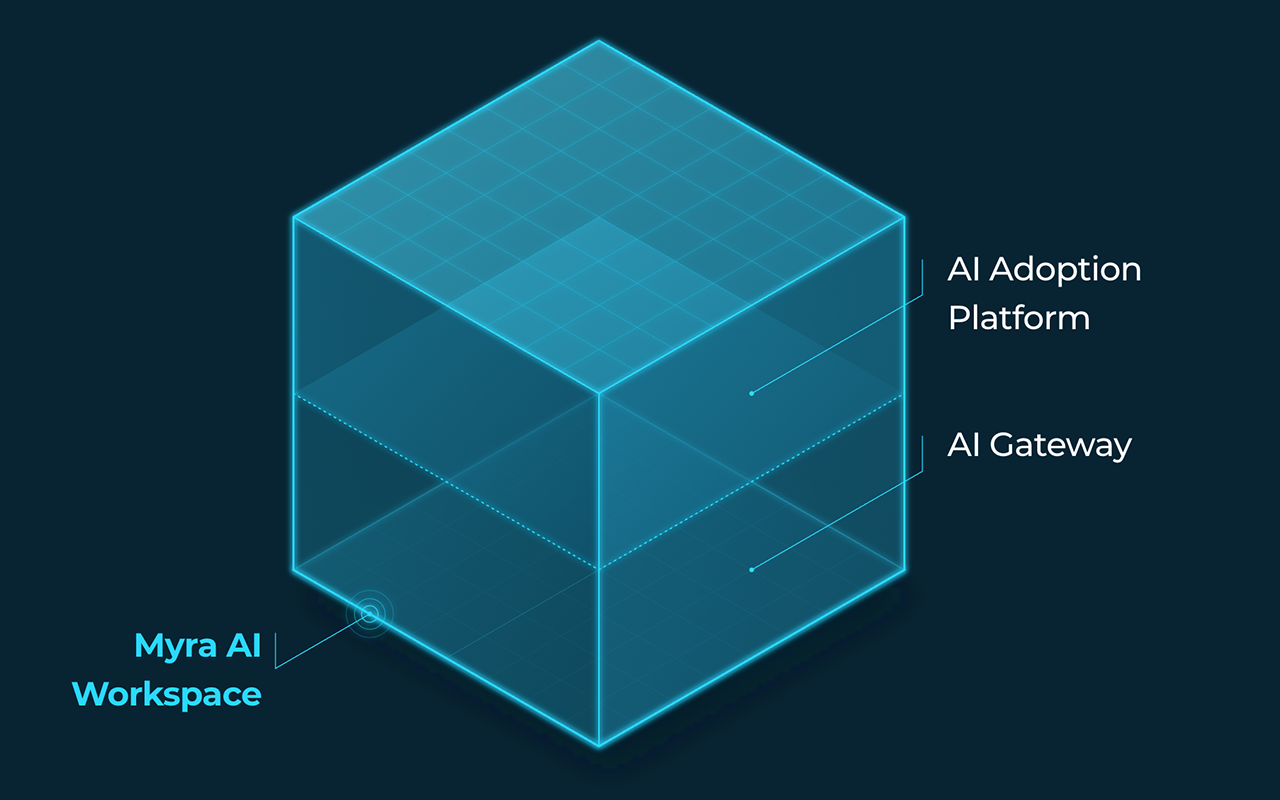
An AI gateway provides control over model access, data flows, guardrails, routing, costs, and audit logs. An AI adoption platform enables employees to use AI productively by providing non-technical access to multiple models, simplified workflows, configurable assistant and agent functions, and collaborative workspaces. Addressing only one aspect usually solves only part of the problem.
Regulated organizations handling sensitive data, in particular, need a solution that combines both: an easy-to-use interface for all employees and a control layer that meets the requirements of IT, security, data protection, and compliance managers. This article categorizes both approaches, identifies their advantages and limitations, and highlights what regulated organizations handling sensitive data should keep in mind when rolling out AI.
What a Conventional AI Gateway Does
An AI gateway acts as a central control layer between users, internal applications (e.g., knowledge management with AI search or support tools with AI-powered responses), and AI providers. Every chat and API request passes through this gateway before reaching a model. This allows policies, guardrails, routing rules, cost limits, and audit logs to be enforced in one place.
For technical teams, the value lies primarily in the architecture. Instead of maintaining separate API keys, integrations, and policies for each model provider, a gateway abstracts the provider layer. A central endpoint can unify access to different models. This makes it possible to implement model changes, fallbacks, or routing rules without having to reconfigure each application.
Traditional gateway products without their own chat interface are primarily aimed at developer and platform teams. While this makes sense for API-based applications, it is often insufficient for widespread use and adoption across all departments of an organization.
Advantages of an AI Gateway:
Access to multiple models via a single endpoint
Centralized management of API keys and provider access
Routing, fallbacks, and rate limits
Configurable guardrails for prompts and responses
Audit logging for chat and API requests
Cost allocation by client, team, application, or user
Scalable infrastructure instead of fragmented individual integrations
Limitations of a conventional AI gateway:
The focus is often on technical teams
Business departments often do not receive their own chat interface
The risk of “shadow AI” due to personal accounts or individual subscriptions remains
Widespread adoption depends on additional front ends or in-house developments
Collaborative features such as projects, file uploads, or shared conversations are usually missing
Productivity gains outside of technical teams are only addressed to a limited extent
What a Dedicated AI Adoption Platform Does
An AI adoption platform is designed for productive use by employees and business units. It makes AI capabilities accessible so that even non-technical teams can work with multiple models, templates, workflows, file contexts, shared workspaces, and easily configurable agent or assistant functions.
The added value lies in abstracting technical complexity and the resulting high level of adoption across the board. Employees do not need to know which provider offers which API, how prompts are technically structured, or how a workflow is executed in the background. Business departments gain productive access to multiple AI models via a chat interface, allowing them to select the right model for every use case.
However, pure adoption platforms without a robust control layer also have their limitations: While they provide user-friendly multi-model access, they generally do not offer granular control options regarding data residency, auditability, guardrails, model routing, or cost limits.
Advantages of an AI adoption platform:
Non-technical access to multiple AI models via a chat interface
Productive AI use without extensive training
Simplified creation of workflows, templates, and assistant functions
Support for collaborative workflows across projects, files, and shared contexts
A single contract and a multi-tenant model instead of many siloed solutions and individual subscriptions
Faster implementation of productive AI use cases across teams
Limitations of a AI adoption platform:
Governance depends heavily on the depth of the control layer
Multi-model access does not automatically mean controlled model routing
Guardrails are often less flexibly configurable without a gateway layer
Auditability may not be sufficient for regulated organizations
Data residency and data flows cannot always be precisely controlled
Technical teams often have less control over API access, routing, and monitoring
Cost limits and cost allocation often remain imprecise without gateway logic
What This Means for Organizations That Handle Sensitive Data
AI rollouts rarely fail due to a single factor. Four forces act simultaneously and in different directions: productivity, control, costs, and compliance. If only one of these is optimized, the others come under pressure.
A conventional gateway optimizes control and costs but often fails to promote productivity across the board. A pure adoption platform optimizes productivity but provides only limited coverage of governance, auditability, and data flow control if the underlying control layer is missing.
Internal auditors, regulatory agencies, and data protection authorities, however, expect verifiable controls: What data was processed? Which model was used? Which guardrails were active? Where were prompts, responses, and audit data processed and stored?
Organizations with sensitive data therefore need an architecture that brings all levels together. Employees need secure, easy access to AI. IT, security, and compliance managers require a control layer that makes every request visible, manageable, and traceable.
Myra Combines AI Adoption and Governance
This is exactly where Myra AI Workspace comes in: It combines a chat interface, a central OpenAI-compatible endpoint, access to over 20 leading models, configurable guardrails (e.g., PII masking and jailbreak protection), an audit-traceable audit trail, and granular cost control. Adoption, governance, and operability are thus consolidated into a single platform. This makes AI accessible to the entire organization without sacrificing control over data flows, costs, and evidence.
In the AI Workspace, prompts, responses, guardrail decisions, routing information, and audit logs all pass through the central control layer. For organizations handling sensitive data, it is therefore crucial whether this layer operates under European law, whether requests and audit data remain within the EU, and whether the underlying infrastructure is designed for regulated environments.
As a German company with a 100% EU shareholder structure and no U.S. parent company, Myra is not subject to the CLOUD Act. The gateway, guardrail sidecars, and audit storage run on Myra’s own EU infrastructure, which is BSI-KRITIS-qualified and certified to ISO 27001 based on BSI IT-Grundschutz, BSI C5 Type 2, PCI DSS, and other standards. Organizations that rely on Myra’s infrastructure include, among others, Deutsche Kreditbank (DKB), 1&1 Versatel, Aleph Alpha, the Munich Security Conference (MSC), and Edeka.
Try AI Workspace for free and learn how multi-model access, guardrails, audit logging, and cost control work together – for productive AI use while protecting your sensitive data.
About the author


Björn Greif
Senior Editor
About the author
Björn started his career as an editor at the IT news portal ZDNet in 2006. 10 years and exactly 12,693 articles later, he joined the German start-up Cliqz to campaign for more privacy and data protection on the web. It was then only a small step from data protection to IT security: Björn has been writing about the latest trends and developments in the world of cybersecurity at Myra since 2020.