New: AI Workspace – Secure AI for Organizations With Sensitive Data. Learn more.
What Is the Best AI Model? It Depends on the Task.
SECURITY INSIGHTS | September 28, 2026
Companies are under pressure to adopt generative AI quickly and company-wide – preferably by making a single, simple decision in favor of “the one” model. But this very simplification overlooks just how different AI tasks actually are in everyday work and how differently models respond to them.

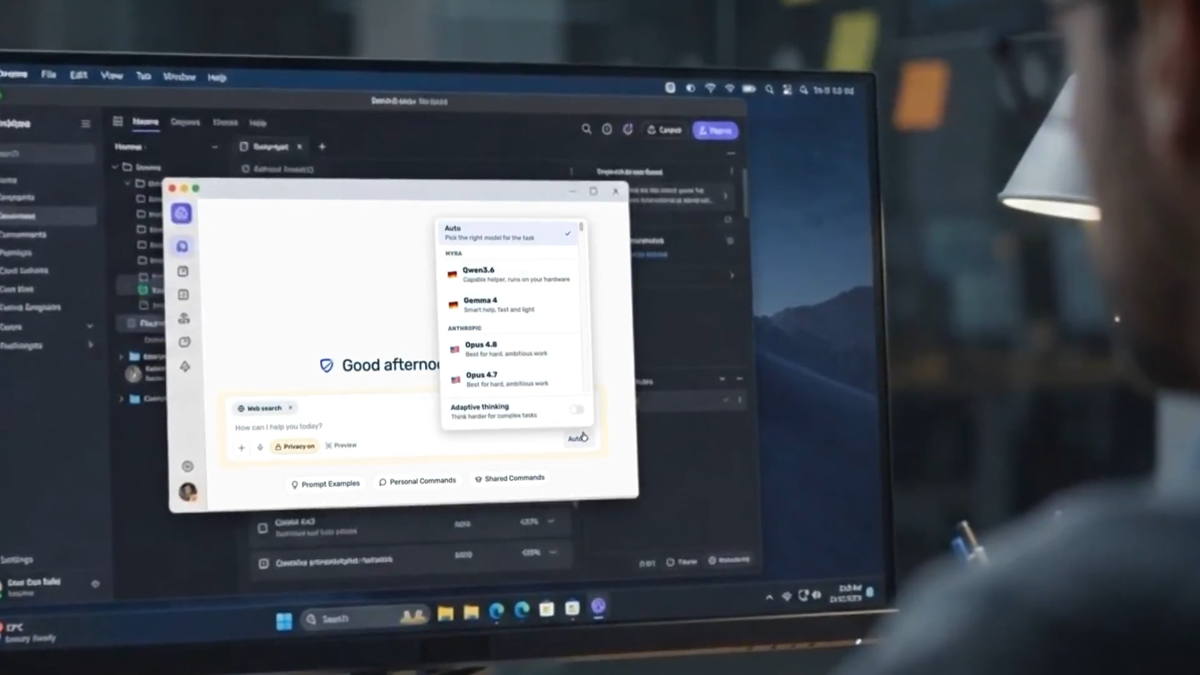
There is no one-size-fits-all answer to the question of which AI model is best. One provider, one model, one integration: this would help limit complexity and make generative AI quickly available within the company.
However, this logic applies a traditional software decision-making process to a market that operates differently. AI models have different strengths and are therefore not equally suited for every task.
One model may excel at programming but struggle with text generation. Another may process images and long documents but be unnecessarily slow for simple routine tasks. Other models can be run within a company’s own IT environment. This gives the company more control over data, access, and the location of processing, but also requires it to provide additional infrastructure.
This shifts the original model question from a procurement decision to an operational one: organizations must ensure that a suitable AI model is reliably available for each task, rather than selecting a universal “best” model.
A Model Ranking Does Not Reflect Everyday Work
The model market is becoming less and less like a linear ranking. Frontier models set the standard for sophisticated reasoning, planning, and tool usage. At the same time, distinct performance peaks are emerging in areas such as efficiency, multimodality, coding, long contexts, and controllable operating modes.
Even open-weight models do not constitute a uniform alternative to closed models. Their use cases range from agent-based software development to multimodal tasks to RAG and enterprise workloads. In addition to the model category, the interplay of quality, cost, modality, and operational requirements is crucial.
Benchmarks can help with initial selection. However, they are no substitute for an evaluation within your own process. Results also depend on prompting, data, context, tool integration, and evaluation methods. Furthermore, vendor benchmarks are often only comparably to a limited extent due to differing test conditions.
The operationally relevant question is therefore not: “Which model tops the rankings?” but rather: “Which model reliably meets our requirements for this task?”
The Right Model Is More Productive Than the Most Powerful One
In day-to-day business operations, AI tasks differ based on a few key criteria. Some must be processed particularly quickly. Others require a high level of analytical depth. Some contain sensitive data, while others combine text, images, audio, or code.
A sales team needs quick summaries, meeting preparations, and email drafts. A legal team requires transparent analyses of lengthy documents and controlled handling of confidential information. In software development, understanding code, repository context, and tool usage are crucial. In customer service, fast response times and reliable results for recurring inquiries are key.
A single standard model inevitably creates friction:
If it is too weak, the effort required for verification and post-processing increases.
If it is unnecessarily powerful, simple processes become slower or more expensive.
If modalities or integrations are missing, additional tool switches are required.
If the operational model does not fit the data context, meaningful use cases are ruled out due to data protection and compliance risks.
The goal of a multi-model strategy is to achieve an ideal fit for the respective task. The sheer number of available AI models is irrelevant as long as a suitable, secure, and compliant model is available for every practical application.
A Multi-Model Strategy Begins with Specific Usage Scenarios
Not every use of AI follows a fixed process. Often, it involves individual tasks such as research, analysis, or summarizing documents. Therefore, the specific requirements of a given request are crucial.
For example, a sales representative might research publicly available information about a potential customer. A fast, general-purpose model is sufficient for this. If they needs to develop a complex market analysis based on that information, a more powerful model may be more appropriate. If, on the other hand, the request contains confidential customer data, it is processed exclusively using a locally deployed model approved for that purpose.
The situation is different in a recurring support process. An efficient model classifies incoming requests and generates initial response suggestions. Complex complaints are forwarded to a more powerful model. If a ticket contains personal data, stricter processing rules apply.
This creates a routing logic that covers both fixed processes and individual tasks. New models can be tested and integrated without changing how employees work. Strategic flexibility thus means making the right model available for every use case, regardless of which model trend currently dominates.
On-Premises Operations Complement the Cloud
Models run locally or in controlled cloud environments open up new applications for data that cannot easily be processed by external providers. Access, logging, and data storage can be more closely aligned with internal guidelines.
However, “Open Weight” does not automatically mean that a model can be operated efficiently on-premises. Large open models still require significant GPU capacity as well as expertise in serving, monitoring, security, and updates. Even for smaller variants, performance and hardware requirements depend on quantization, context length, and workload.
Local operation is therefore not a universally superior alternative to the cloud. It is an operational option for specific requirements. In practice, this leads to a hybrid mix: carefully managed models handle sensitive or domain-specific tasks, efficient cloud models handle high volumes, and frontier models handle particularly complex cases.
The strategic strength lies in the ability to combine these approaches.
A Shared Operating Shift Makes the Most of Model Diversity
More models alone won’t solve the problem. Without a common framework, they lead to parallel APIs, individual tools, multiple integrations, and inconsistent rules.
Even centralized access isn’t enough. The additional freedom of choice creates new complexity if it remains unclear which model should be used for a specific task. A multi-model platform must therefore combine access to different models with clear guidelines for selecting them.
There are essentially three ways to achieve this:
Assignment at the team level: Department heads, IT, and compliance managers determine which models a business unit is permitted to use and make them available.
Selection at the user level: Experienced employees select models themselves from those approved for their use.
Intelligent assignment: A “concierge” takes into account the request, context, data class, and quality requirements and automatically forwards the request to the appropriate approved model.
These approaches can complement one another. Teams are provided with a defined model framework; experienced users can choose for themselves when necessary; and the concierge handles the selection when clear rules can be applied.
Various models are available to support this in the background: efficient models for routine tasks, high-performance models for complex analyses, specialized models for code or media content, and models operated under controlled conditions for sensitive data.
The platform thus serves as a shared operational layer between day-to-day work and the model marketplace. It not only provides various models but also ensures that every request follows the appropriate and authorized processing path.
Myra AI Workspace as a Shared Model Layer
Myra AI Workspace follows this principle. Through an OpenAI-compatible access point, applications and workflows can use different models without having to set up a separate integration for each provider.
Routing rules tailor the selection to the use case, data class, and quality requirements. Role-based models, multi-tenancy, and guardrails create a common framework for different business units. Controlled models can complement the portfolio when data or operational requirements demand it.
Myra is a German company with a 100% EU shareholder structure, no U.S. parent company, and no CLOUD Act exposure. Gateway, guardrail sidecars, and audit storage run on Myra’s own EU infrastructure, which is BSI KRITIS-qualified and certified to ISO 27001 based on BSI IT-Grundschutz, BSI C5 Type 2, PCI DSS, and other standards. Organizations that rely on Myra’s infrastructure include Deutsche Kreditbank (DKB), 1&1 Versatel, Aleph Alpha, the Munich Security Conference (MSC), and Edeka, among others.
Sign up for a demo and learn how you can use Myra AI Workspace to provide your employees with the right model for every task – without compromising on security, data protection, and compliance.
About the author


Stefan Bordel
Senior Editor
About the author
Stefan Bordel has been working as Editor and Technical Writer at Myra Security since 2020. He is responsible for the strategic development and editorial management of all content formats – from website content and specialist publications to whitepapers, social media communication, and technical documentation. In this role, he combines solid expertise from IT journalism with in-depth technical understanding in the field of cybersecurity. As a long-time Linux enthusiast, he closely follows developments in the IT industry both professionally and personally.