New: AI Workspace – Secure AI for Organizations With Sensitive Data. Learn more.



Key Takeaways
What an AI platform for enterprises does: It combines a user workspace for employees (chat, projects, documents) with a control layer for policies, models, and budgets.
What selection hinges on: Security and data protection, hosting location and jurisdiction, model selection, governance and roles, costs, integration, and support.
Additionally important for organizations with sensitive data: The provider’s ownership structure, exposure to the US CLOUD Act, PII masking, audit log, and certifications/assurance reports such as ISO 27001 or BSI C5.
What you should require from the provider: Written answers with evidence, such as a data processing agreement, a list of subprocessors, a contractual commitment regarding training, and certificates with scope of applicability.
How to make the rollout succeed: Assess current state, define requirements, test providers in a pilot, configure policies, roll out in stages.
What you can clarify up front: Use the checklist to evaluate providers consistently and document the decision for procurement, data protection, and audit.





The Most Important Criteria for an AI Platform for Enterprises
Security and data protection
Which data reach the model, and who can see them?
PII masking, guardrails, encryption, audit log, certifications, model training with inputs, retention
Functional description of masking or pseudonymization, DPA with list of subprocessors, contractual clause on training, certificates or assurance reports
Hosting location and jurisdiction
Which laws govern the provider and the infrastructure?
Corporate headquarters, ownership, CLOUD Act exposure, subcontractors, data residency, location of models
Commercial register excerpt, group structure, description of forwarding and failover
Model selection
Can models be chosen and switched freely?
Number and origin of models, open‑weight models, BYOK, lock‑in risk, scoping per project
Model list with operator for each model, per‑project settings
Governance and roles
Who may do what, and how is this evidenced?
SSO, RBAC, multi-tenancy, inheritable policies, delegated administration, four‑eyes approvals
Role overview, audit log documentation
Costs
Are costs predictable and attributable?
Pricing model, budgets, cost attribution, caching, consolidation
Complete price overview including add‑ons
Integration
How does the platform fit into the IT landscape?
Interfaces, identity integration, SIEM, connectors, UI, account management
Interface documentation, responses in the statement of work/specification
Support and contract
Who supports operations, and what applies on termination?
Points of contact, onboarding, pilot, contractual framework, exit and data export
Draft contract with response times, termination periods, and exit provisions
Security and data protection
Which data reach the model, and who can see them?
Hosting location and jurisdiction
Which laws govern the provider and the infrastructure?
Model selection
Can models be chosen and switched freely?
Governance and roles
Who may do what, and how is this evidenced?
Costs
Are costs predictable and attributable?
Integration
How does the platform fit into the IT landscape?
Support and contract
Who supports operations, and what applies on termination?
This is where data protection and information security officers decide whether to approve a rollout of a secure AI platform at all. The concern is concrete: According to a Bitkom survey, 58% of companies cite data protection requirements and the lawful usability of data as obstacles to using AI, and 45% fear company data falling into the wrong hands. A suitable, secure AI platform therefore enforces data protection principles technically rather than leaving them to policies and training.
In short: A secure AI platform masks personal data before sending it to external models, routes confidential content to models on controlled infrastructure, mitigates the risk of disclosing business secrets via configurable rules, and documents processing in an audit log.
What to look for:
Data processing: Is there a data processing agreement under Art. 28 GDPR, and which subprocessors are named?
Training with inputs: Are prompts, files, or responses used to train models?
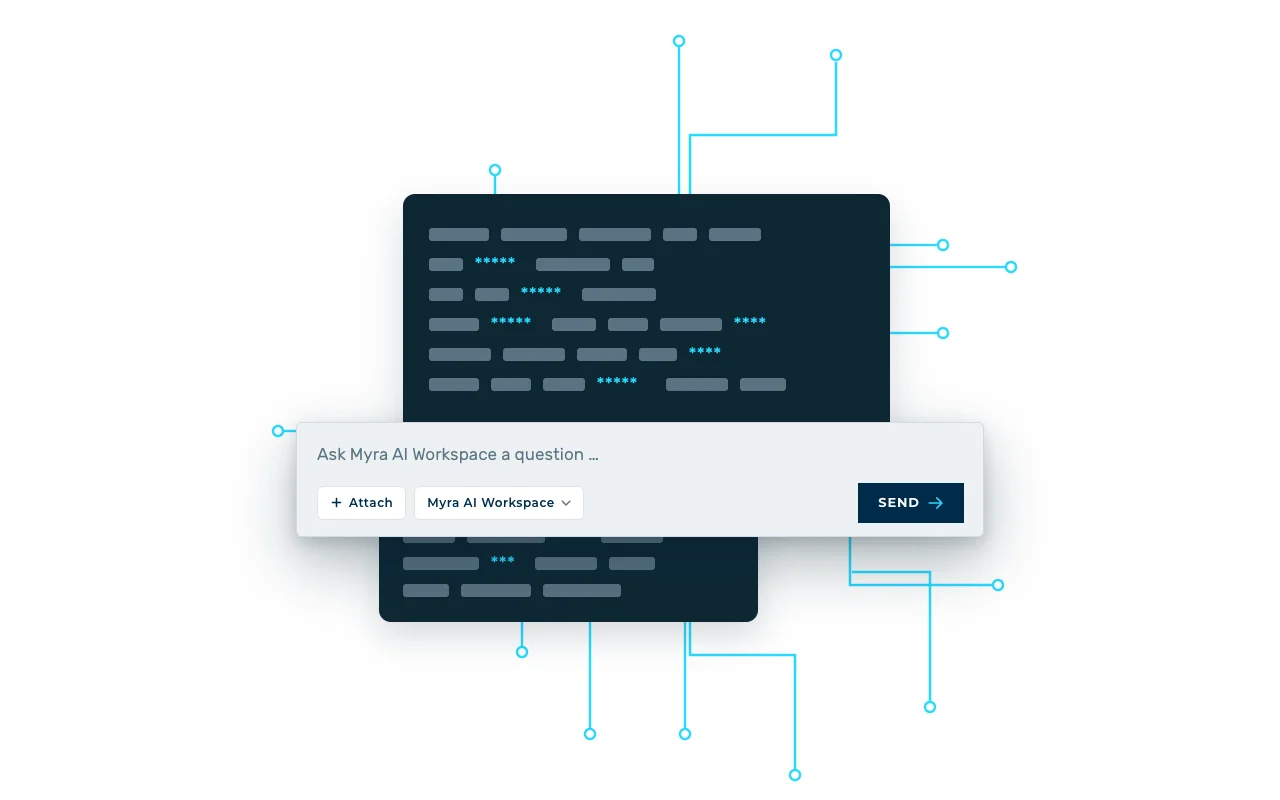
Data minimization: Does the platform detect personal data such as names, IBANs, or phone numbers and replace them with placeholders before the model request? This implements the data minimization principle under Art. 5 GDPR technically. With reversible tokenization, original values reappear in the response.
Protection levels by data class: Can particularly confidential content be routed to models running on controlled infrastructure, while less sensitive requests may go to frontier models? Can models be restricted per project or group instead of only tenant-wide?
Protection of trade secrets: Can rules block items like internal project names, source code, or customer numbers before they leave the company?
Protection against manipulation: Are there guardrails against prompt injection and jailbreak attempts?
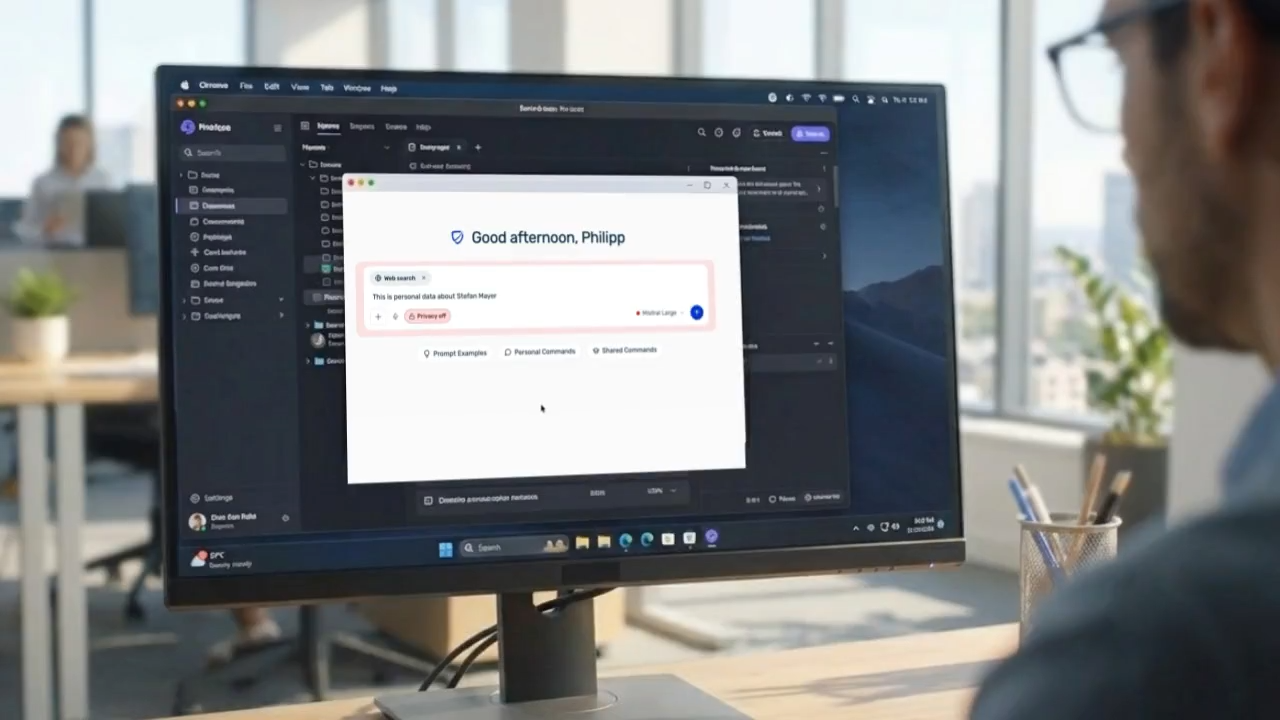
Transparency for users: Can non-technical employees see in the interface which protection mode they are currently working in?
Traceability: Are requests logged with model, user, timestamp, and applied rules? Do admin changes and security events appear in a tamper-evident audit log to facilitate DPIAs, data subject access requests, and audits?
Storage of inputs: How long are prompts and responses stored, and can storage be shortened or disabled?
Provider evidence: Which certificates and assurance reports does the provider hold, e.g., ISO 27001 based on BSI IT‑Grundschutz or BSI C5 Type 2?
When reviewing, it helps to distinguish three layers that often blur in product descriptions: where the application runs, where the models run, and which laws govern the provider.
A data center in Frankfurt alone does not guarantee a European legal framework. If the provider or its parent company is subject to US law, US authorities can request access to data stored in the EU via the CLOUD Act. Therefore, the main company domicile, ownership structure, and the chain of subcontractors count just as much as the server location.
There is also legal uncertainty around data transfers to the US. The EU‑U.S. Data Privacy Framework has facilitated them since 2023 but is politically and legally contested and already the subject of new lawsuits. Keeping data flows within the EU legal area from the outset avoids dependence on a potential invalidation.
However, a European platform does not automatically prevent individual requests from being subject to US law. If you use a model from a US provider via the platform, that model provider remains subject to US law. For sensitive data classes, it therefore also matters which models are approved.
In short: For an AI platform’s jurisdiction, server location, corporate headquarters, and the provider’s ownership structure all matter. Only if all three lie within the EU legal area and no US parent company is involved is the platform provider’s exposure to the CLOUD Act significantly reduced. For models from US providers used via the platform, US law still applies.
What to look for:
Corporate headquarters and owners: Where is the provider based, and are there owners or parent companies outside the EU?
Infrastructure: Does the provider operate its own infrastructure, or does it rent capacity from US hyperscalers? In which country does the application run, and with which data center operator?
Location of models: Where do the models run, including under peak load or if a provider fails?
Subcontractors: Which subprocessors are involved, and where do they process data?
Data residency by data class: Can it be technically enforced that certain requests are processed only by models in the EU? What is the default?
Transparency before sending: Does the interface show which data are going to which external model provider?
Critical infrastructure and sector requirements: Is the provider familiar with regulated-sector requirements, e.g., relating to NIS‑2, DORA, or healthcare regulations?
No single large language model (LLM) is equally suitable for every task. One model summarizes long contracts well, another writes better code, a third is more cost‑effective for simple requests. At the same time, the market is changing very quickly. A platform tied to a single provider makes the organization dependent on that provider’s prices, terms, and availability.
Conversely, uncontrolled variety does not help: A multitude of unvetted models creates an approval problem for data protection and information security. The decisive factor is whether selection can be scoped by data class or project.
In short: A future‑proof enterprise generative AI platform provides access to multiple model providers, including European and open‑weight models, through a unified interface. This allows you to choose models by task, scope them per project, and switch easily, which lowers vendor lock‑in risk.
What to look for:
Breadth of offering: How many models and providers are connected? Are European providers such as Mistral included?
Operation of models: Which models does the provider operate itself, and which are passed through from third parties?
Open‑weight models: Can open models be used on trustworthy, controlled infrastructure, e.g., for highly sensitive data and trade secrets?
Model switching: Is there an OpenAI‑compatible interface so applications continue running unchanged when switching?
New models: Can you use new models without amending the contract?
Bring Your Own Key (BYOK): Can existing contracts with model providers be integrated via your own API keys? How are these keys stored?
Admin control: Can admins define which models are approved for which teams and data classes? Can individual models be blocked and projects restricted to specific models?
Availability: Do fallback rules kick in if a provider fails?
Governance answers who may use which AI functions with which data and how this can be evidenced to audit and oversight. Regulatory obligations add to this: Since February 2025, the EU AI Act requires organizations to ensure adequate AI competence among their employees. Further obligations are being phased in through 2027. A platform does not replace these organizational measures, but it provides the technical basis to enforce and document rules.
In short: Governance in an enterprise AI platform means centrally defining access rights, model approvals, data protection rules, and budgets, and managing them separately for organization, teams, and users. An audit log makes every decision traceable.
What to look for:
Identities: Can the platform be connected to the directory service via SSO (SAML or OpenID Connect)?
Roles and rights: Is there role‑based access control (RBAC) with separate permissions for admins, data protection, team leads, and users?
Approvals: Who approves agents and workflows, and is a four‑eyes approval possible for critical changes?
Organization policy: Can an internal AI policy be stored that the system takes into account in chat?
Levels of control: Can policies be set at organization, team, and user levels?
Multi‑tenancy: Can subsidiaries, business units, or agency divisions be managed as separate tenants with their own models, budgets, and policies?
Inheritable minimum standards: Do central requirements (e.g., “PII masking always on”) apply to all units, which may tighten but not undercut them?
Delegated administration: Can business units manage their teams themselves, while information security retains authority over guardrails and model approvals?
Access restrictions: Can access be limited to defined networks via IP allowlists?
Audit log: What is logged, who can view and change logs (including customer admins?), and how long are they retained? Are tampering attempts on logs detectable?
Resources for the AI Act and GDPR: Does the provider offer templates, exports, or reports that support internal evidence and review processes?
AI costs arise in several places at once: platform fees, per‑user licenses, token consumption at model providers, and effort for introduction and operations. For procurement and controlling, list price matters less than whether total costs can be planned, attributed, and limited. Fully clarify the pricing model before testing.
In short: The costs of an AI platform usually consist of a platform fee, user licenses, and token consumption. They become predictable through budgets at multiple levels, precise cost attribution by team and model, and the consolidation of prior individual subscriptions.
What to look for:
Pricing transparency: Which components are billed? Are there markups on token prices, and are they disclosed?
Security in the base plan: Are functions you need for data security—such as SSO, audit features, or locally hosted models—included in the base price or only available as add‑ons?
Own keys: Are there additional costs for BYOK?
Budgets: Can caps be set for the organization, teams, and individual users? What happens in case of an unexpected spike in load?
Cost attribution: Does the platform show who used which model when and at what cost? Is cost‑center reporting available for internal chargeback?
Savings levers: Is there caching of identical requests? Can cheaper models be automatically prescribed for simple tasks?
Consolidation: Which existing individual subscriptions and departmental licenses does the platform replace?
Hidden costs: How high are integration, training, and operational efforts? With open‑source solutions, license costs disappear but not costs for infrastructure, updates, and personnel.
An AI platform only becomes the standard if it fits into existing systems and workflows. For IT leadership, technical connectivity to identity management, monitoring, and line‑of‑business applications counts. For acceptance in business units, the question is whether the interface is understandable without training.
In short: A well‑integrated AI platform connects to the directory service via SSO, manages user accounts automatically, provides an OpenAI‑compatible interface for your own applications, streams logs to SIEM and monitoring, and offers an intuitive interface modeled on common chat tools.
What to look for:
Account management: Are user accounts automatically provisioned and deprovisioned on join/leave, e.g., via SCIM?
Interface for your own applications: Can internal tools, chatbots, or knowledge search use the platform via a standardized API?
Monitoring and security: Can logs be forwarded in real time to SIEM and monitoring systems such as Splunk, Elastic, OpenSearch, Syslog, or Prometheus?
Connectors: Are there connections to business systems, e.g., via the Model Context Protocol (MCP)? Are these accesses subject to the same rules as chat requests? Can knowledge sources such as SharePoint or Confluence be connected?
Collaboration tools: Are there interfaces to Microsoft Teams, Slack, or comparable tools?
Interface for business units: Are chat, shared projects, and file uploads available? Is the UI aligned with familiar tools so that even less experienced users can get started immediately?
Collaboration: Can teams share projects, knowledge bases, and conversations?
Migration effort: How many applications need to be adapted, and what support does the provider offer?
In procurement, support is often examined last; in operations, it is felt first. Especially in a young market segment, it pays to look at who is reachable during incidents, how transparently the provider communicates its product development, and how an exit works.
In short: For support on an AI platform for enterprises, accessible points of contact, guided onboarding, the possibility of a pilot project, a lean contractual framework with a GDPR‑compliant DPA, a defined process for security incidents, and regulated paths for data export and exit all matter.
What to look for:
Points of contact: Are there dedicated, German‑speaking contacts and defined response times?
Onboarding and pilot: Does the provider assist with setup and configuration? Is a time‑boxed pilot with your own use cases possible?
Contractual framework: Is there a data processing agreement? How many contracts and contracting parties are needed in total?
Term and termination: What contract term and termination periods apply?
Security incidents: How and within what timeframe does the provider inform you of security incidents?
Availability of features: Which features are in production today, and which are on the roadmap?
Exit: Can data, projects, and logs be exported in common, open formats? How long are data stored after contract end?
Experience with regulated industries: Is the provider familiar with the review processes of banks, insurers, public authorities, or clinics?
Requirements by Company Size
The seven categories apply to all organizations. However, the weighting varies depending on size.
Which AI Platform Suits Small and Mid‑Sized Businesses (SMB)?
In SMBs, the same person often handles IT operations and information security. Building and maintaining your own infrastructure for a generative AI platform for enterprise ties up capacity needed elsewhere. Accordingly, the criteria differ from those in large enterprises:
Managed service instead of self‑hosting: A fully managed platform with a dedicated tenant saves the effort of building and maintaining your own infrastructure.
Ready‑to‑use defaults: Preconfigured data protection rules and guardrails allow a quick start without having to develop every rule yourself.
Interface and control from one source: No side‑by‑side of a gateway layer and a separate chat application.
Few contracts: One provider means one DPA, one point of contact, and less coordination effort.
Growth path: The platform should start with a few users and later scale to teams, budgets, and your own applications.
In short: For small and medium‑sized businesses, AI platforms as a managed service with a dedicated tenant, preconfigured protection rules, an integrated chat interface, a European legal framework, and a single contracting party are particularly suitable.
Which Selection Criteria Are Relevant for Large Organizations?
Enterprises, public authorities, and corporate groups work with many units, separated responsibilities, and strict operational requirements. This leads to additional requirements for an AI platform for enterprises:
Multi‑tenancy: Subsidiaries, business units, or agency divisions get separate tenants with their own models, budgets, and policies, managed through a shared platform.
Inheritable policies: Group‑wide minimum standards (e.g., PII masking always on) apply centrally. Individual units may tighten them but cannot undercut them.
Delegated administration: Business units manage their teams and budgets themselves, while the security team retains authority over guardrails and model approvals.
Network and access controls: IP allowlists, enforced SSO, and fine‑grained RBAC restrict who can access the gateway from where.
SIEM integration: Logs are streamed in real time to the Security Operations Center and correlated with other events.
Chargeback: Analyses by cost center, model, and project enable accurate internal billing.
High availability: Fallback chains across multiple model providers, circuit breakers, and load distribution safeguard business‑critical applications.
Data residency: Routing rules ensure certain data classes are processed only by models in defined legal areas.
Governance for agents: Tool calls via the Model Context Protocol (MCP) also run through the gateway and are subject to the same rules as direct chat requests.
12 Key Questions for Vendor Evaluation
Are personal data automatically masked before being passed to external models?Is the provider headquartered in the EU, with no US parent company involved?Does the platform run on owned or on rented infrastructure, and where?Are multiple model providers available, including European and open‑weight models?Can models be switched without code changes and scoped per project?Can policies and budgets be set separately for organization, teams, and users?Are admin changes and security‑relevant events documented in a tamper‑evident audit log that can be integrated with SIEM systems?Which certificates and assurance reports are available (e.g., ISO 27001, BSI C5 Type 2)?Is the chat interface designed so it is usable without training even by inexperienced users?Are pilot, data export, and contract termination clearly regulated?Is there a DPA with a complete list of subprocessors?Is it contractually excluded that your inputs are used to train models?
How Myra AI Workspace Meets the Criteria
Myra AI Workspace is designed for organizations that handle sensitive data and wish to use generative AI while meeting strict data protection and governance requirements. The following points illustrate how Myra AI Workspace addresses the selection criteria mentioned above. Which requirements are relevant in each specific case depends on the level of protection needed, the industry, and the existing IT infrastructure.
Security and data protection
Two protection levels: open‑weight models on Myra‑owned EU infrastructure for particularly sensitive data; automatic PII masking for working with frontier models. Color coding always shows users the active protection mode. Configurable guardrails including protection against prompt injection. Myra does not use customer data to train AI models. Myra’s infrastructure holds a BSI C5 Type 2 attestation.
For external models, the respective model providers’ conditions also apply.
Hosting location and jurisdiction
German company headquartered in Munich with 100% EU ownership structure, no CLOUD‑Act exposure for models hosted by Myra: gateway, guardrails, and audit storage run on Myra‑owned infrastructure in the EU.
For models from US providers, the respective model provider remains under US law.
Model selection
Access to models from 20+ providers via an OpenAI‑compatible endpoint, including European providers such as Mistral. Own keys (BYOK) in an AES‑256‑encrypted key vault, automatic routing. Project‑level “Local only” access mode blocks cloud models as well as web search and external tools.
–
Governance and roles
Policies and protection modes granularly for organization, teams, and users; tenant management, RBAC, IP allowlists. Audit log covers admin changes and security events. Four‑eyes approval for certain changes.
–
Costs
Myra AI Workspace starts at €13 per user per month plus VAT; feature scope and monthly usage quota vary by plan. Budgets at three levels (organization, teams, users), cost attribution by team, model, and user; a cache for identical requests reduces the cost of repeated prompts.
–
Integration
Chat and projects usable via an intuitive interface without training; MCP connectors; log streaming to Splunk, Elastic, OpenSearch, Syslog, and Prometheus. SSO (OIDC, SAML), integration with SharePoint, MS Teams, Slack, Mattermost, and Confluence, export at contract end in open formats.
–
Support and contract
One contract instead of multiple individual subscriptions. For existing Myra customers: no new procurement process, no new DPA.
–
Security and data protection
Two protection levels: open‑weight models on Myra‑owned EU infrastructure for particularly sensitive data; automatic PII masking for working with frontier models. Color coding always shows users the active protection mode. Configurable guardrails including protection against prompt injection. Myra does not use customer data to train AI models. Myra’s infrastructure holds a BSI C5 Type 2 attestation.
Hosting location and jurisdiction
German company headquartered in Munich with 100% EU ownership structure, no CLOUD‑Act exposure for models hosted by Myra: gateway, guardrails, and audit storage run on Myra‑owned infrastructure in the EU.
Model selection
Access to models from 20+ providers via an OpenAI‑compatible endpoint, including European providers such as Mistral. Own keys (BYOK) in an AES‑256‑encrypted key vault, automatic routing. Project‑level “Local only” access mode blocks cloud models as well as web search and external tools.
Governance and roles
Policies and protection modes granularly for organization, teams, and users; tenant management, RBAC, IP allowlists. Audit log covers admin changes and security events. Four‑eyes approval for certain changes.
Costs
Myra AI Workspace starts at €13 per user per month plus VAT; feature scope and monthly usage quota vary by plan. Budgets at three levels (organization, teams, users), cost attribution by team, model, and user; a cache for identical requests reduces the cost of repeated prompts.
Integration
Chat and projects usable via an intuitive interface without training; MCP connectors; log streaming to Splunk, Elastic, OpenSearch, Syslog, and Prometheus. SSO (OIDC, SAML), integration with SharePoint, MS Teams, Slack, Mattermost, and Confluence, export at contract end in open formats.
Support and contract
One contract instead of multiple individual subscriptions. For existing Myra customers: no new procurement process, no new DPA.
Frequently Asked Questions (FAQ) About AI Platforms for Enterprises
An AI platform for enterprises is software that provides approved AI models via a shared chat interface for all employees. Beneath it lies a control layer that enforces rules for data protection, access rights, model choice, and costs and logs usage. This replaces scattered single tools and personal accounts with a governed standard.